
Logistics Dispatch and Proof of Delivery Software: Close the Loop
Dispatch creates the promise. Proof of delivery proves it. A practical guide to the features that matter, the handoffs that fail, and how to evaluate one connected chain from order to signed delivery and billing.
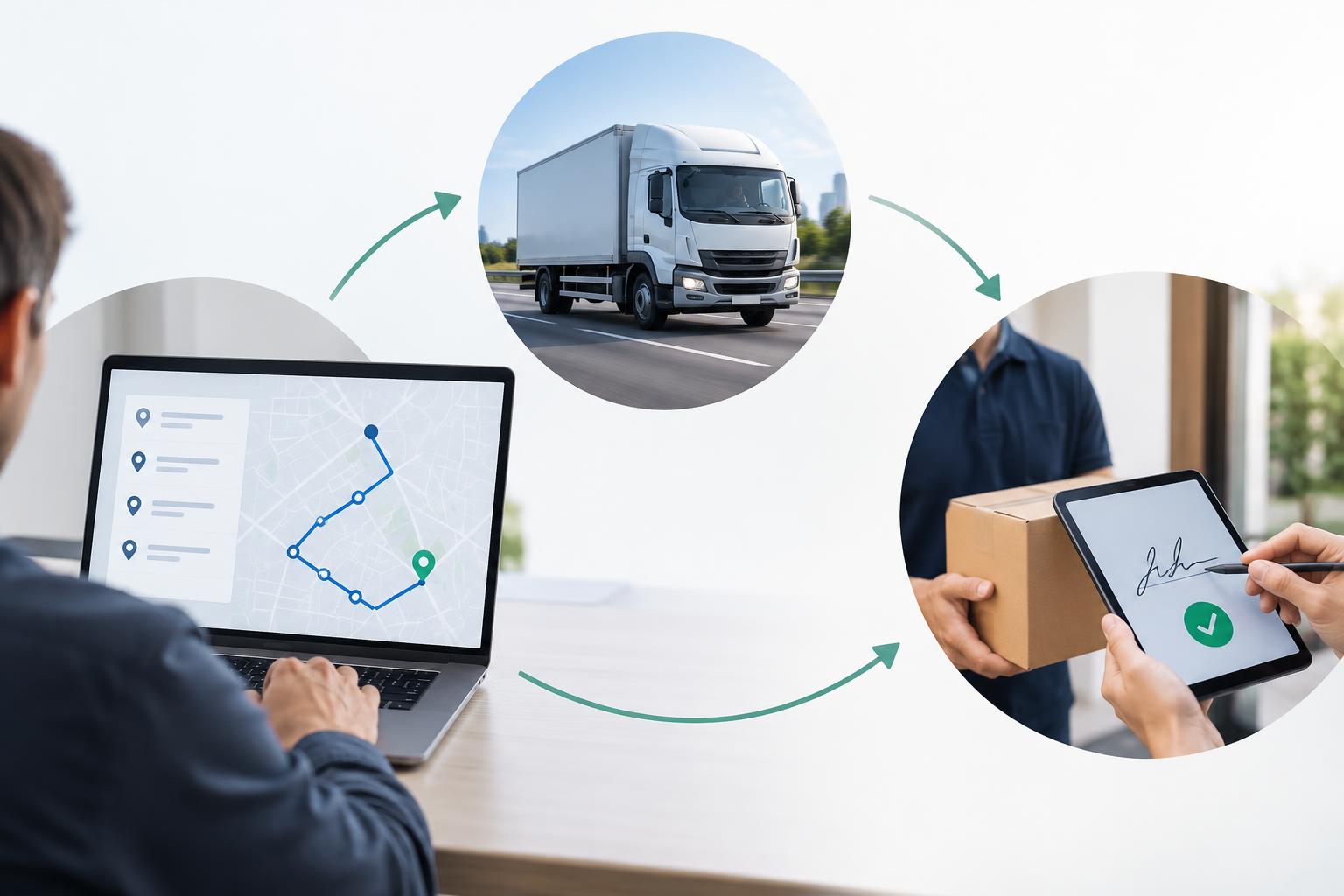
Dispatch creates the promise. Proof closes it.
Dispatch software creates a promise. Proof of delivery software proves whether the promise was kept. When those jobs live in separate tools, the gap becomes the operation: phone calls, paper notes, re-keyed data, disputed invoices, and managers rebuilding the truth at the end of the day.
The fix is not more features. It is one chain of evidence from order to assignment to delivery to billing. That is the standard to evaluate logistics dispatch and proof of delivery software against.
Start with the handoff that fails
Most dispatch processes look fine at the start. An order arrives, a dispatcher assigns it, and a driver gets the job. The weakness appears at the handoff: the driver arrives, the customer signs a paper sheet, the sheet goes missing, and the invoice waits. Or the driver marks delivered, but no one can show who received the goods, when, or in what condition.
A useful system makes that handoff visible. The dispatch record and the delivery record should be the same record. The status should not be a claim typed by a human. It should be backed by evidence captured at the point of delivery.
What dispatch software should do
Good dispatch software does more than list jobs. It should:
- Capture orders with the details drivers need: address, contact, time window, priority, special handling, and expected items.
- Assign work by capacity, location, skills, and urgency, then sequence stops in a practical order.
- Send the job to a driver app with clear instructions and a status trail.
- Show live progress and flag exceptions before they become customer complaints.
- Support re-assignment and route changes without losing the audit trail.
The driver experience matters as much as the dispatcher screen. If the app is slow, unclear, or unusable when connectivity drops, the data will be incomplete. Ask how the app handles poor coverage, failed deliveries, and partial handovers. The answers reveal whether the software was designed for real routes or for a demo.
What proof of delivery must capture
Proof of delivery is not a scanned signature on a PDF. It is structured evidence. At minimum, a delivery record should answer:
- Who received the goods, and in what role?
- When and where was the handover made?
- What was delivered, including quantities and serial or barcode references where relevant?
- What condition was it in?
- Was the delivery complete, partial, rejected, or rescheduled?
- What evidence supports the answer: signature, photo, scan, timestamp, location, or notes?
The best systems capture several forms of evidence and tie them to the order. A signature alone can be disputed. A photo without a timestamp or location is weak. A timestamp without a recipient identity is incomplete. Together, they create a defensible record.
Auditability matters too. A proof-of-delivery record should be append-only or otherwise protected from silent edits. If a dispute arises weeks later, the operation needs to show what was recorded at the time, not what someone changed afterward.
Why one system beats two
The case for one logistics dispatch and proof of delivery system is simple: the same event should update dispatch, customer service, billing, and reporting.
When dispatch and POD are separate:
- Customer service sees one status and the delivery team sees another.
- Billing waits for paperwork or, worse, goes out before proof exists.
- Disputes take hours to reconstruct because evidence sits in different tools.
- Performance metrics measure activity, not outcomes.
When they are one chain:
- A signed delivery updates the order and triggers the next step.
- A failed delivery creates an exception task with the evidence attached.
- The invoice is tied to verified delivery, not a dispatcher's memory.
- Managers can see which routes, drivers, or customers generate exceptions.
This is the difference between tracking work and proving it. Tracking tells you where a vehicle is. Proof tells you what was handed over, to whom, and whether the order can be closed.
A practical evaluation checklist
Use a real route to test any system. Pick one normal day and one bad day. Then ask:
- Can an order move from intake to dispatch to delivery to billing without re-keying?
- Does the driver app capture signatures, photos, scans, notes, and failure reasons in a structured way?
- Can the system handle partial deliveries, rejected items, and rescheduling without breaking the order history?
- Are status changes timestamped and tied to a user and a device?
- Can billing be held until proof is verified, and released automatically when it is?
- Can supervisors correct errors without deleting the original record?
- Do reports separate on-time dispatch from on-time delivery, and delivered from proven?
- Can the system support your language, currency, and tax requirements without custom work?
- What happens when the driver has no signal?
- How long does it take to add a new customer, route, or delivery type?
If the vendor cannot demonstrate the exception path, the happy path is not enough.
Where FleetCheeta fits
Dal Dom builds and operates vertical software. FleetCheeta is its logistics and supply chain platform. Dal Dom describes it as running dispatch, live tracking, warehouse, and billing as one system, from dispatch to signed proof of delivery, on its own IP.
That combination is the point. Dispatch is not a standalone screen. It connects to warehouse activity and billing. It also serves the wider Dal Dom portfolio: FleetCheeta moves Maktabi's maintenance and supply runs and fulfils ProcureIn's procured goods. The product is certified by SATE, Dal Dom's execution truth platform, which exists to verify that products do what they claim.
We build software that earns its place. That means operational truth before product truth, and proof over description. For logistics teams, the practical test is whether the system can carry one order from assignment to signed delivery without losing the evidence along the way.
If you are evaluating logistics dispatch and proof of delivery software, start with the handoff. Then test the exception. Then check whether billing follows proof. If you want dispatch, tracking, warehouse, and billing to run as one chain, let's talk.