
AI Sales Orchestration on WhatsApp: A Practical Guide
WhatsApp is a sales channel, not an inbox. AI sales orchestration turns inbound messages into qualified leads and governed next steps—without pretending a chatbot can run the whole relationship.
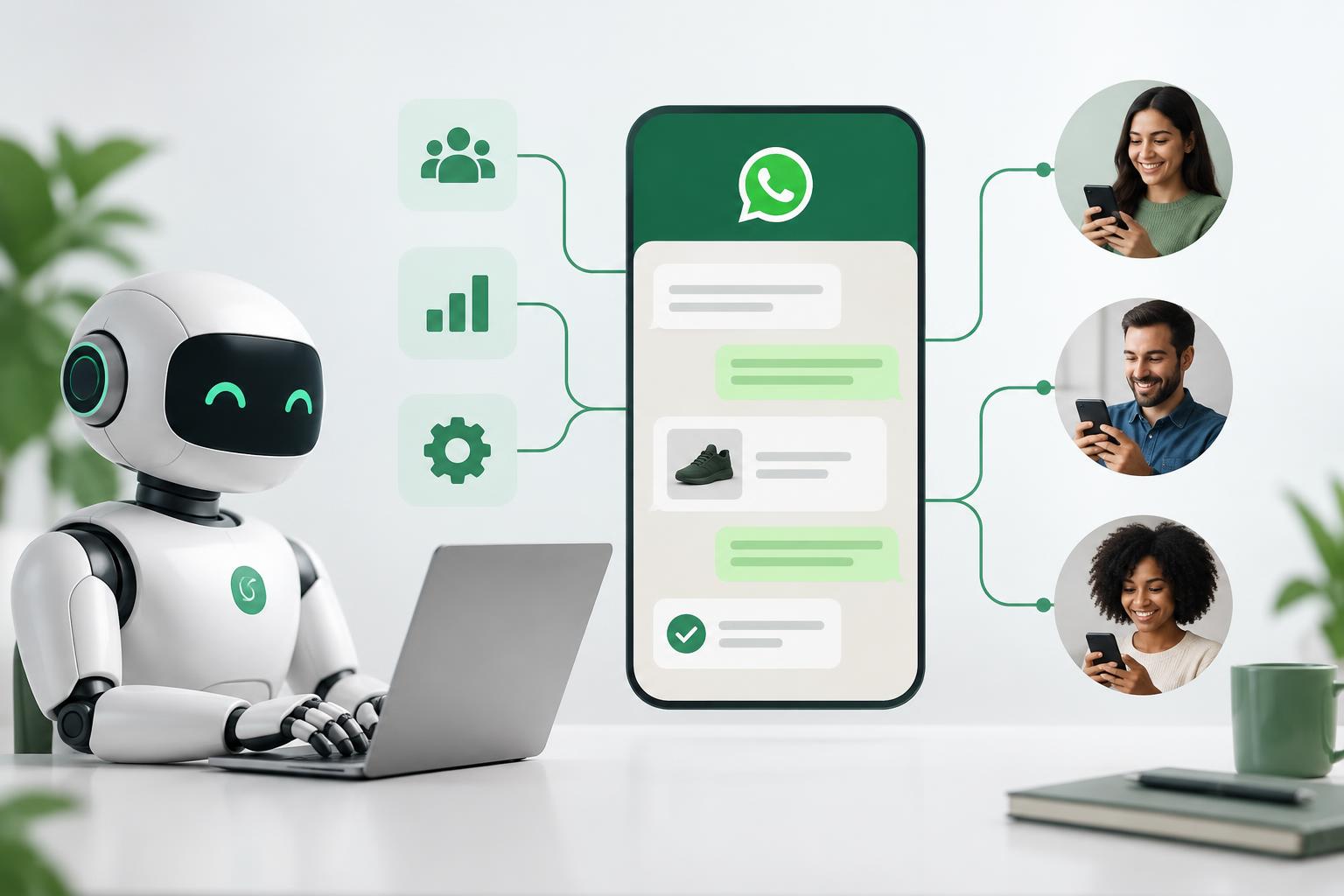
The problem is the fifth message, not the first
A lead messages at 9:12pm. "Do you still have the unit?" The first reply is easy. The next ten are not. Is this a tenant, an agency or a decision-maker? What is the budget? Is the objection price, timing or trust? Should the system ask another question, offer an appointment or stop? A scripted bot can answer the first message. It struggles with the fifth.
That is the case for AI sales orchestration on WhatsApp. Not another chatbot. A system that runs the conversation as a process: understand the lead, choose the next move, respond, record the outcome and improve. For property managers, landlords and agencies, these are leasing enquiries, renewals and payment questions. For any sales team, they are pipeline. Speed alone is not enough. Consistency and judgement matter more.
Chatbot versus orchestration
A chatbot is one responder. Orchestration is a chain of services working on every inbound message.
We build this kind of system. Maktabi's outreach platform is not a chatbot. It is a layered, self-improving AI system with 208 production service components orchestrating every inbound message in real time. We can embed the same architecture into other B2B or B2C products.
Read the person, not just the text
Three AI models work in parallel per message. A fast model classifies intent and sentiment. A deep reasoning model handles strategy and qualification. A creative model generates an empathetic response. In Maktabi, those roles are handled by GPT-4o-mini, DeepSeek-R1 and GPT-4o.
The system also builds a live profile: role, persona, language and emotional state. Owners, agents, accountants and decision-makers are not treated the same. Neither are skeptics, trust-seekers, risk-averse buyers and early adopters. Arabic, English, Urdu and Tagalog are detected by AI, not keyword rules. Emotional intensity is scored from 1 to 10.
Govern the conversation
Every conversation sits in one of 12 states, including nurture, soft_close, recover, retain, close_now, disengage, deal_close, agency_convert and churn_prevent. Transitions follow strict rules enforced by a governance service. Every one is logged with a timestamp, reason and prior state history. A conversation with states has a defined next step, a defined exit and an audit trail. A conversation without them drifts.
Predict before responding
A prediction model runs on every turn. It estimates conversion, churn, upsell, appointment and discount interest. Results are cached for five minutes and invalidated when signals change. A/B variants are assigned per conversation, and outcomes feed back into strategy weights. Predictions are decision support, not certainty. They help decide when to answer, ask, move to a call or wait.
Handle objections systematically
Price, timing, trust, need, competitor, authority, complexity, features and data privacy are among 14 objection categories. Each has dedicated rebuttal strategies with adaptive weights. If a tactic performs poorly, its weight decreases and a softer approach is preferred. The system learns what works on your audience instead of repeating a script.
Qualify and keep context
Six services build a real-time lead profile. One classifies the contact as an agency, property manager, landlord, tenant or general consumer. Another extracts fields such as location and budget. Voice notes are transcribed and cleaned. Images such as receipts, documents and property photos are analysed, so document-heavy conversations do not stall.
What it looks like in property management
A prospect asks about availability and price. The system detects role, language and urgency. It captures qualification fields such as location and budget. It decides whether to answer, ask for one more detail or present a next step. If price becomes an objection, it selects the relevant strategy. If sentiment turns to anger, the revenue engine's guard prevents a discount. Discounts are one-use and require minimum onboarding progress.
Every transition is logged. A human can step in with context instead of rereading a messy thread. Churn prediction and renewal engines can flag retention risk before renewal.
Maktabi also handles rent cycles, digital payments via Tap, compliant e-invoicing, maintenance dispatch and a native iOS and Android back office. The WhatsApp conversation is not isolated from operations.
Beyond property
The same pattern fits other high-intent WhatsApp traffic. A B2B supplier qualifies a quote request. A field sales team follows up after a visit. A procurement team collects documents. The channel changes. The orchestration problem does not: know the person, choose the next action, keep an audit trail.
Production readiness matters. Our stack includes multi-tenancy, webhook architecture, payment integration, queued job pipelines and the WhatsApp Business API. Maktabi is multi-tenant by agency, with audit-grade controls and native mobile apps. These details decide whether the system survives real volume.
The controls that make it usable
AI sales orchestration is not a licence to automate everything. Keep these controls in place:
- Consent and opt-out. Respect the channel's rules and the contact's preferences. A fast reply is not worth a blocked number.
- Human escalation. Route edge cases, high-value deals and angry customers to a person.
- Accurate source data. Orchestration cannot fix wrong availability, vague pricing or outdated policies.
- Audit and review. Log decisions, not just messages. Review why the system chose a discount, a handoff or a close.
- Quality controls. Hallucination prevention, anti-repetition and response quality checks belong in the pipeline.
- Outcome measurement. Track qualified conversations, appointments, conversion, churn saves, handoff rate and opt-outs. Do not measure message volume and call it success.
A practical starting point
Pick one conversation with clear revenue, such as a leasing enquiry or renewal. Define its states and exit conditions. Build the objection library from real conversations. Connect the facts the system is allowed to use. Pilot with human review. Measure outcomes. Then widen the scope.
Do not start with every use case. Start with the conversation that pays for the work.
Build the channel properly
AI sales orchestration makes WhatsApp more useful by making it more disciplined. The goal is not a bot that talks more. It is a system that qualifies better, follows up consistently and gives your team cleaner decisions.
We build software that earns its place. Maktabi's WhatsApp-native AI sales engine is in production. We can embed the architecture into your product and stay on to support it. If WhatsApp is a serious sales channel for your business, let's talk.